


Can pegboard support heavy items like frequently used kitchen utensils and spice bottles for extended periods without deformation?
Release Time : 2025-12-03
In modern kitchen storage design, pegboard has quickly become a popular choice for improving space efficiency and enhancing aesthetics due to its open structure, flexible combinations, and attractive appearance.
The load-bearing capacity of pegboard primarily stems from the inherent strength of its base material. High-quality products typically use carbon steel as the main material, a metal with excellent rigidity and tensile strength. More importantly, the board is not simply punched and used; it undergoes precise bending, reinforcing ribs, or edge binding during manufacturing. These structural designs, though subtle, act like beams and columns in a building, significantly increasing overall bending stiffness without substantially increasing thickness. Especially when pegboard is installed horizontally on a wall, the bent structures at the top and bottom edges effectively resist sagging caused by heavy loads hanging in the middle, keeping the board straight and stable.
Secondly, while the surface coating primarily serves decorative and anti-corrosion purposes, its application process also indirectly affects structural integrity. The coating, achieved using advanced processes such as electrostatic powder coating, is not only uniform and dense, resistant to oil and smoke corrosion, but also forms a strong bond with the substrate. This prevents blistering and peeling caused by moisture or temperature differences, which could expose the metal substrate and lead to corrosion. Once corrosion occurs, it weakens the board from the inside, eventually causing localized softening or even perforation. Therefore, the durable and stable coating is truly an "invisible guardian" for long-term load-bearing.
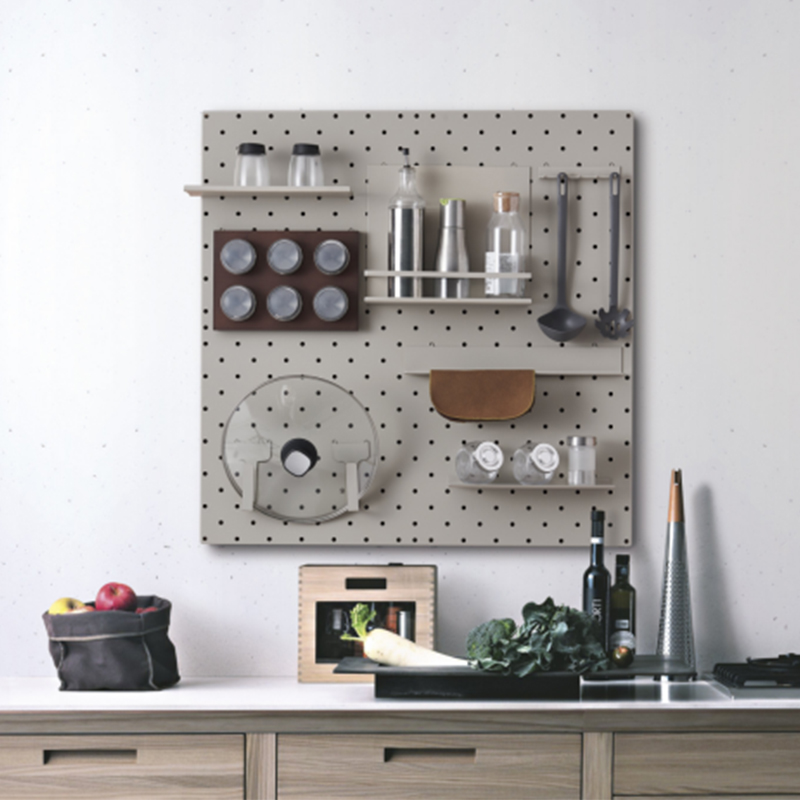
Of course, the board itself alone is not enough to ensure complete safety; proper installation is equally crucial. A truly reliable pegboard system must be firmly fixed to the load-bearing wall using expansion bolts or specialized anchors, not just relying on adhesives or lightweight hangers. The number and distribution of fixing points need to be rationally planned according to the board dimensions, especially with additional support points below areas where heavy objects are suspended. Furthermore, the choice of accessories is also critical—high-quality hooks and shelves should be made of thickened metal and fully embedded in the holes to prevent excessive stress on a single point, which could cause tearing or slippage at the hole edges.
It's worth noting that the "load-bearing capacity" of a pegboard doesn't refer to hanging extremely heavy items in a single location, but rather emphasizes its overall load-bearing capacity when rationally distributed. For example, distributing multiple spice bottles across different areas is far safer than concentrating all the weight in one place. This distributed approach is the wisdom of open storage systems: it encourages users to dynamically arrange items based on their weight and usage frequency, optimizing retrieval efficiency while naturally achieving load balance.
Finally, long-term stability also depends on routine maintenance. Regularly checking for loose screws, deformed hooks, and abnormal bending of the board surface are all effective measures to extend its lifespan. High-quality pegboards are designed with a service life of several years or even longer in mind, with structural redundancy and material durability sufficient to withstand the humidity, temperature variations, and frequent handling in a kitchen environment.
Ultimately, a truly reliable pegboard is the result of the combined effect of materials, structure, installation, and usage. It's not just wall decoration, but an extension of kitchen functionality. When the spatula hangs securely and the condiment bottles are neatly arranged, the sense of security that comes from not having to worry about them falling or getting deformed is precisely the gentle promise that meticulous craftsmanship makes to daily life—carrying the order and composure of everyday life within a small space.
The load-bearing capacity of pegboard primarily stems from the inherent strength of its base material. High-quality products typically use carbon steel as the main material, a metal with excellent rigidity and tensile strength. More importantly, the board is not simply punched and used; it undergoes precise bending, reinforcing ribs, or edge binding during manufacturing. These structural designs, though subtle, act like beams and columns in a building, significantly increasing overall bending stiffness without substantially increasing thickness. Especially when pegboard is installed horizontally on a wall, the bent structures at the top and bottom edges effectively resist sagging caused by heavy loads hanging in the middle, keeping the board straight and stable.
Secondly, while the surface coating primarily serves decorative and anti-corrosion purposes, its application process also indirectly affects structural integrity. The coating, achieved using advanced processes such as electrostatic powder coating, is not only uniform and dense, resistant to oil and smoke corrosion, but also forms a strong bond with the substrate. This prevents blistering and peeling caused by moisture or temperature differences, which could expose the metal substrate and lead to corrosion. Once corrosion occurs, it weakens the board from the inside, eventually causing localized softening or even perforation. Therefore, the durable and stable coating is truly an "invisible guardian" for long-term load-bearing.
Of course, the board itself alone is not enough to ensure complete safety; proper installation is equally crucial. A truly reliable pegboard system must be firmly fixed to the load-bearing wall using expansion bolts or specialized anchors, not just relying on adhesives or lightweight hangers. The number and distribution of fixing points need to be rationally planned according to the board dimensions, especially with additional support points below areas where heavy objects are suspended. Furthermore, the choice of accessories is also critical—high-quality hooks and shelves should be made of thickened metal and fully embedded in the holes to prevent excessive stress on a single point, which could cause tearing or slippage at the hole edges.
It's worth noting that the "load-bearing capacity" of a pegboard doesn't refer to hanging extremely heavy items in a single location, but rather emphasizes its overall load-bearing capacity when rationally distributed. For example, distributing multiple spice bottles across different areas is far safer than concentrating all the weight in one place. This distributed approach is the wisdom of open storage systems: it encourages users to dynamically arrange items based on their weight and usage frequency, optimizing retrieval efficiency while naturally achieving load balance.
Finally, long-term stability also depends on routine maintenance. Regularly checking for loose screws, deformed hooks, and abnormal bending of the board surface are all effective measures to extend its lifespan. High-quality pegboards are designed with a service life of several years or even longer in mind, with structural redundancy and material durability sufficient to withstand the humidity, temperature variations, and frequent handling in a kitchen environment.
Ultimately, a truly reliable pegboard is the result of the combined effect of materials, structure, installation, and usage. It's not just wall decoration, but an extension of kitchen functionality. When the spatula hangs securely and the condiment bottles are neatly arranged, the sense of security that comes from not having to worry about them falling or getting deformed is precisely the gentle promise that meticulous craftsmanship makes to daily life—carrying the order and composure of everyday life within a small space.