


Why is the column-style open cloakroom becoming a new favorite for modern home storage?
Release Time : 2025-12-30
Against the backdrop of evolving contemporary living concepts, people's expectations for home space have long surpassed mere functionality and space, shifting towards a pursuit of visual openness, efficient function, and a fusion of lifestyle aesthetics. Traditional closed wardrobes, while capable of storing items, often appear bulky and oppressive, and their fixed internal structure makes them difficult to adapt to changing storage needs. The column-style open cloakroom, with its lightweight structure, flexible layout, and minimalist visual language, is quietly becoming a new favorite for modern homes, especially urban residences and boutique apartments.
Its core appeal lies first and foremost in the sense of space created by "openness." Without cabinet doors obstructing the view, the eye can freely penetrate, making potentially cramped corners feel spacious and bright. Especially in small apartments with limited natural light, the open design maximizes the introduction of natural light, and when combined with light-colored materials or metal frames, creates a light and airy visual effect, making the room appear larger and more refreshing. This "de-enclosed" approach aligns with modern people's desire for a living space that combines a sense of openness and order.
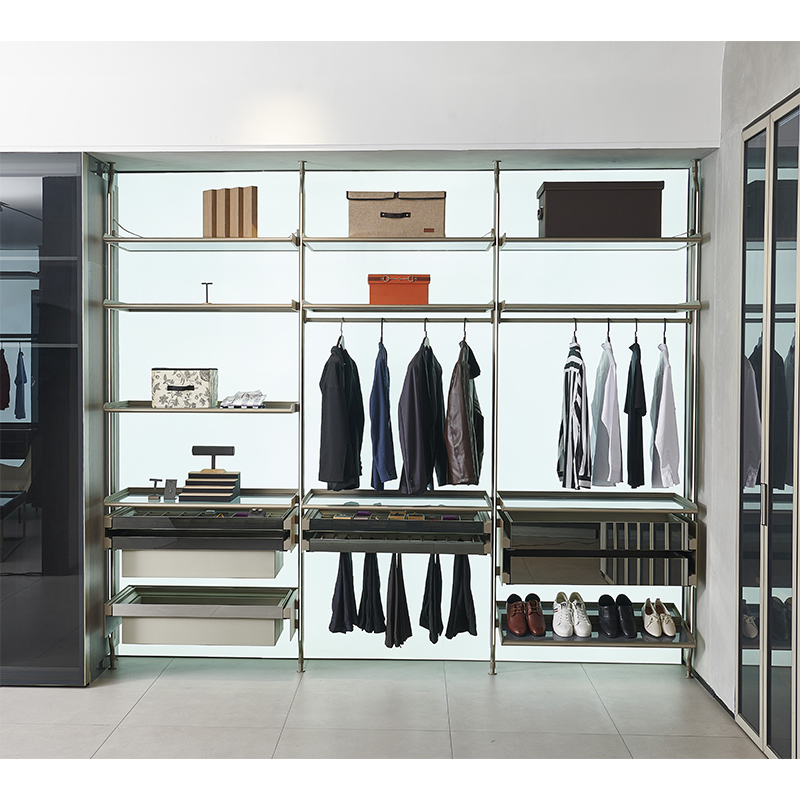
The column structure provides the system with exceptional flexibility and adaptability. Using vertical columns as the framework, modules such as clothes rails, shelves, drawer units, trouser racks, and shoe racks can be freely combined, allowing users to adjust the layout according to clothing type, usage frequency, and even seasonal changes. Today, more hanging space is needed to display suits and coats; tomorrow, shelves can be added to store folded sweaters—all without alteration, simply by adjusting height or adding/removing accessories. This "growth-oriented" storage system truly realizes "space serving people," rather than people conforming to a fixed layout.
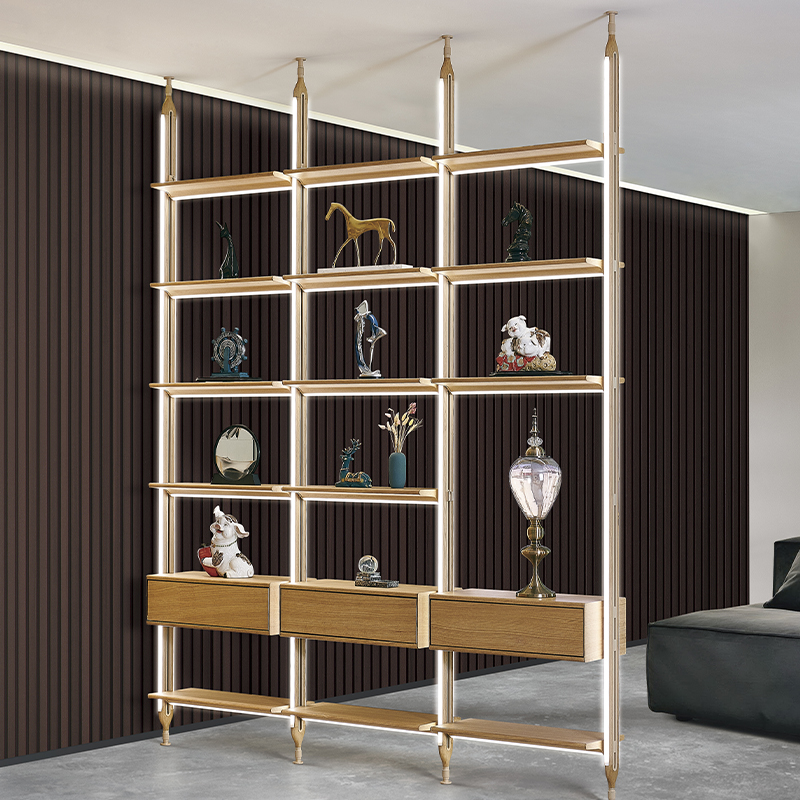
Upgraded materials and craftsmanship also free the open-plan cloakroom from the stereotype of a "simple clothes rack." High-quality metal columns, finely brushed or matte-coated, combine strength and texture; paired with warm solid wood or high-density environmentally friendly boards, they achieve a balance of strength and flexibility, providing both structural stability and a cozy atmosphere. Precision hardware ensures hanging rods won't slip and shelves won't loosen, maintaining structural stability even with long-term use. This attention to detail makes the cloakroom not just a functional area, but a design highlight of the space.
In terms of user experience, the open layout greatly improves daily efficiency. Clothes are clearly visible, eliminating the need to rummage, making morning dressing time-saving and effortless; accessories, bags, hats, and other small items can also be displayed separately, offering both display and convenient access. Many users even incorporate vanity mirrors, ambient lighting, and even aromatherapy devices into this area, creating their own "fashion corner," transforming wardrobe organization from a chore into a life ritual.
Furthermore, the column-style open cloakroom is easy to install, requiring no wall damage or custom-made large cabinets, making it particularly suitable for renters, those renovating existing apartments, or families pursuing low-carbon renovations. In the future, when moving or reorganizing the space, the system can be completely disassembled and reused in another location, avoiding resource waste and echoing the concept of sustainable living.
Of course, open-plan design also encourages users to maintain tidiness—this is not a flaw, but a positive guidance: when items are exposed, people are more inclined to categorize and organize, simplifying their possessions, thus achieving a truly "orderly life."
The popularity of column-style open cloakrooms is essentially a microcosm of modern lifestyles: it rejects redundancy and champions transparency; it doesn't conceal flaws, only showcases refinement; it adapts to all changes with flexibility, and embodies richness with simplicity. It's no longer just a place to store clothes, but a mirror reflecting the owner's aesthetics, rhythm, and attitude towards life. When morning light shines on neatly hung coats, when fingertips lightly touch the smooth metal columns, what we feel is not just the convenience of storage, but a concrete expression of an ideal life—simple, free, and orderly.
Its core appeal lies first and foremost in the sense of space created by "openness." Without cabinet doors obstructing the view, the eye can freely penetrate, making potentially cramped corners feel spacious and bright. Especially in small apartments with limited natural light, the open design maximizes the introduction of natural light, and when combined with light-colored materials or metal frames, creates a light and airy visual effect, making the room appear larger and more refreshing. This "de-enclosed" approach aligns with modern people's desire for a living space that combines a sense of openness and order.
The column structure provides the system with exceptional flexibility and adaptability. Using vertical columns as the framework, modules such as clothes rails, shelves, drawer units, trouser racks, and shoe racks can be freely combined, allowing users to adjust the layout according to clothing type, usage frequency, and even seasonal changes. Today, more hanging space is needed to display suits and coats; tomorrow, shelves can be added to store folded sweaters—all without alteration, simply by adjusting height or adding/removing accessories. This "growth-oriented" storage system truly realizes "space serving people," rather than people conforming to a fixed layout.
Upgraded materials and craftsmanship also free the open-plan cloakroom from the stereotype of a "simple clothes rack." High-quality metal columns, finely brushed or matte-coated, combine strength and texture; paired with warm solid wood or high-density environmentally friendly boards, they achieve a balance of strength and flexibility, providing both structural stability and a cozy atmosphere. Precision hardware ensures hanging rods won't slip and shelves won't loosen, maintaining structural stability even with long-term use. This attention to detail makes the cloakroom not just a functional area, but a design highlight of the space.
In terms of user experience, the open layout greatly improves daily efficiency. Clothes are clearly visible, eliminating the need to rummage, making morning dressing time-saving and effortless; accessories, bags, hats, and other small items can also be displayed separately, offering both display and convenient access. Many users even incorporate vanity mirrors, ambient lighting, and even aromatherapy devices into this area, creating their own "fashion corner," transforming wardrobe organization from a chore into a life ritual.
Furthermore, the column-style open cloakroom is easy to install, requiring no wall damage or custom-made large cabinets, making it particularly suitable for renters, those renovating existing apartments, or families pursuing low-carbon renovations. In the future, when moving or reorganizing the space, the system can be completely disassembled and reused in another location, avoiding resource waste and echoing the concept of sustainable living.
Of course, open-plan design also encourages users to maintain tidiness—this is not a flaw, but a positive guidance: when items are exposed, people are more inclined to categorize and organize, simplifying their possessions, thus achieving a truly "orderly life."
The popularity of column-style open cloakrooms is essentially a microcosm of modern lifestyles: it rejects redundancy and champions transparency; it doesn't conceal flaws, only showcases refinement; it adapts to all changes with flexibility, and embodies richness with simplicity. It's no longer just a place to store clothes, but a mirror reflecting the owner's aesthetics, rhythm, and attitude towards life. When morning light shines on neatly hung coats, when fingertips lightly touch the smooth metal columns, what we feel is not just the convenience of storage, but a concrete expression of an ideal life—simple, free, and orderly.