
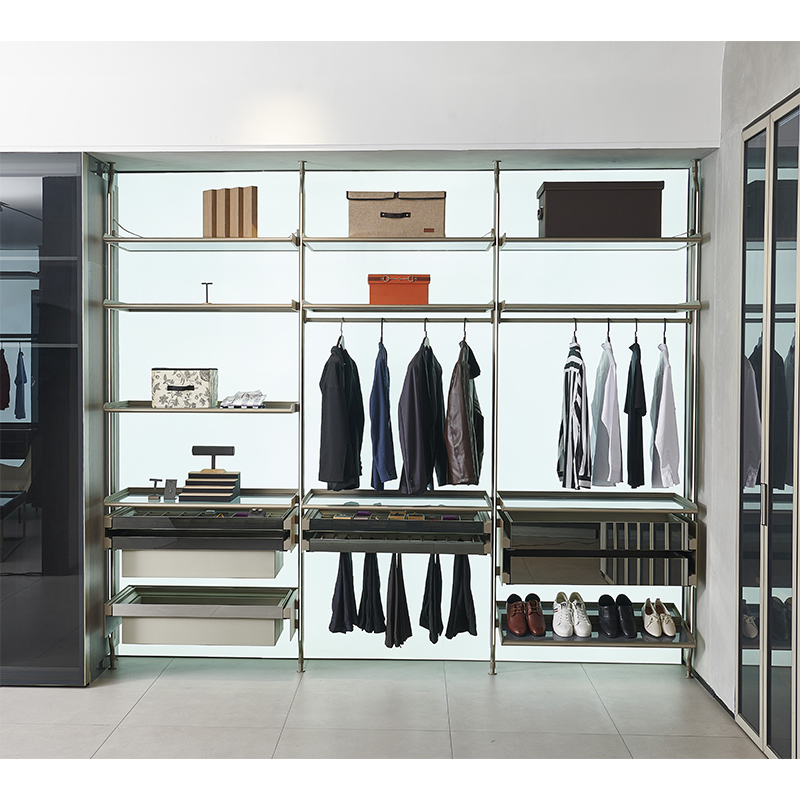


What are the rust prevention treatment processes for the hardware fittings used in column-type open cloakrooms?
Release Time : 2026-02-12
The rust prevention process for hardware accessories in a column-type open cloakroom requires consideration of material characteristics, usage environment, and long-term stability requirements, employing multi-dimensional technical methods to achieve rust prevention goals. Its core processes encompass surface pretreatment, coating protection, electrochemical protection, and environmental control, with each stage working in tandem to form a systematic protection system.
Surface pretreatment is the foundation of the rust prevention process, directly affecting the adhesion and durability of subsequent coatings. Hardware accessories may retain oil, rust, or oxide layers during processing. These require acid pickling, alkaline washing, or solvent cleaning to remove surface impurities, followed by sanding or sandblasting to increase surface roughness and improve the adhesion between the coating and the substrate. For example, stainless steel accessories often undergo acid pickling and passivation with a mixture of nitric acid and hydrofluoric acid, removing stains while forming a dense oxide film; carbon steel accessories require phosphating to generate a phosphate protective layer, providing a good base for subsequent coating.
Coating protection is the most widely used rust prevention method, physically isolating the metal from oxygen and moisture. Common coating types include rust-preventive oils, rust-preventive paints, and electroplating. Rust-preventive oils are suitable for short-term rust prevention or scenarios requiring frequent disassembly. They form an oil film on the metal surface to isolate corrosive media, but require regular reapplication to maintain their effectiveness. Rust-preventive paints provide long-term protection through the synergistic effect of resin and rust-preventive pigments. A combination of epoxy zinc-rich primer and polyurethane topcoat can meet the needs of the humid environment of a walk-in closet. Electroplating processes such as zinc plating and nickel plating achieve protection by depositing a corrosion-resistant metal layer on the metal surface. The zinc plating layer can also protect the substrate through sacrificial anode protection when damaged.
Electrochemical protection inhibits corrosion reactions by altering the potential characteristics of the metal. For walk-in closets in high-humidity environments, sacrificial anode methods can be used, where a more reactive metal (such as magnesium or zinc) is bonded to the surface of the hardware, causing corrosion to preferentially occur on the anodic material. Alternatively, cathodic protection with an applied current can be used, where the metal hardware acts as a cathode connected to a DC power supply, continuously supplying electrons to neutralize the oxidants in the corrosion reaction. These processes are often used for concealed structural components in high-end custom walk-in closets and require specialized equipment and regular maintenance.
Environmental control is a key auxiliary means to extend the service life of hardware components. The interior of a walk-in closet should be kept well-ventilated and dry, with relative humidity controlled below 60% to slow down corrosion. In coastal or high-humidity areas, dehumidifiers or desiccants can be installed to reduce air humidity. Furthermore, avoid direct contact between hardware and corrosive substances such as acidic cleaners and cosmetics. Regularly wiping surface dust with a dry cloth can effectively reduce the risk of localized corrosion.
The application of new rust-prevention technologies provides more options for the protection of hardware. Vapor phase corrosion inhibitors release volatile corrosion inhibitors in a confined space, forming a monomolecular protective film on the metal surface, suitable for long-term rust prevention of closed structures such as drawers and pull-out baskets in walk-in closets. Nano-coating technology utilizes the high activity and small size effect of nanoparticles to build a dense protective layer on the metal surface, combining rust prevention, wear resistance, and self-cleaning functions, and is gradually becoming the mainstream choice for high-end walk-in closet hardware.
The choice of process should comprehensively consider cost, effectiveness, and applicability. For frequently moving parts such as hinges and drawer slides used daily, electroplating or nano-coating with good wear resistance is preferred. For static accessories such as decorative handles and hooks, low-cost anti-rust paint can be used. For concealed connections, long-term protection can be achieved through sacrificial anode or vapor phase corrosion inhibitors. In actual engineering, composite processes are often used, such as phosphating first, then coating with epoxy primer and polyurethane topcoat, and finally adding vapor phase corrosion inhibitor bags in the packaging stage to form a multi-layered protection system.
The anti-rust treatment of column-type open cloakroom hardware needs to be carried out throughout the entire life cycle of design, production, installation, and use. From the application of corrosion-resistant metals in the material selection stage, to the strict pretreatment in the processing, to the precise control of the coating process, and finally to the consolidation of anti-rust effect through environmental management and regular maintenance, close coordination of each link can ensure the long-term stable operation of hardware in complex usage scenarios, providing lasting functional and aesthetic support for the cloakroom.